
Hero-in-Waiting: Vertical Farming in Singapore
By Nathania Frida
In the middle of rising temperatures and an increasingly unpredictable climate, have you ever wondered about the true cost of the food on your plate?
The modern food industry is responsible for 32% of global human-caused greenhouse gas (GHG) emissions (FAO, 2025). A significant share comes from conventional ways of farming, through land clearing, fertiliser use, irrigation and fuel-powered machinery, with further emissions from processing, refrigeration and transportation (Ritchie, 2020).
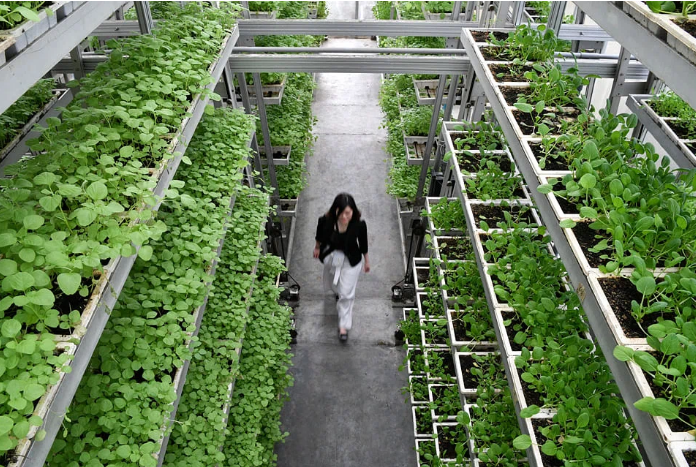
The solution might be less conventional than you think. Vertical farming brings food production closer to where it is consumed while growing crops in controlled, stacked environments. Growing food closer to our tables shortens transport distances, reducing associated emissions and food losses along the journey. Beyond reducing transport distances, these systems can reduce reliance on heavy agricultural machinery and deliver nutrients directly to plants without conventional soil-based fertiliser application. In land-scarce Singapore, this is almost the perfect solution.
The vertical farming process begins with incubation, where seeds are germinated before healthy seedlings are transferred into growing towers or racks. During planting and growth, nutrient-rich water is circulated directly to the roots and can often be collected and reused, improving water efficiency. Farmers carefully control light, nutrients, temperature and water quality, using LED lighting indoors or natural sunlight outdoors, while some systems use aquaponics to recycle nutrients from fish waste. Once mature, crops are harvested and replaced with new seedlings, allowing production to continue in repeated cycles without the need to clear or prepare conventional farmland between harvests.
Perhaps the coolest thing about vertical farming is its flexibility.
Systems can be built indoors or outdoors, expanded with additional towers, and adapted to spaces ranging from rooftops to unused urban areas. In theory, farms can also be combined with other technologies, such as renewable energy, food-waste treatment or aquaculture, to create increasingly circular food systems.

So if vertical farms are so ideal, why are they not everywhere in Singapore?
Cost
Building a vertical farm requires substantial upfront investment in growing structures, pumps, sensors and specialised equipment, creating a high barrier to entry that can deter potential investors and new operators. In land-scarce Singapore, limited space often pushes farms indoors, where artificial lighting and climate control add to operating costs and electricity consumption.In fact, electricity demand is one of vertical farming's major environmental hotspots (Martin et al., 2023).
Local vegetables still have to compete with imports
Singaporean farms must compete with produce that can often be grown more cheaply overseas. Higher operating costs therefore make it difficult for local farms to compete without charging consumers more (Mohamad, 2025).
What can we do?
Vertical farming highlights a familiar challenge in sustainability: a greener solution is often the more expensive one. While the technology shows how engineering, agriculture and circular-economy thinking can reshape how cities produce food, its potential ultimately depends on making sustainability financially viable.
Its future may depend on technologies beyond farming itself such as cheaper clean electricity could gradually change the economics of urban agriculture.
For now, this is what we can do: Next time you are buying vegetables, take a second look at where they came from and look for the red SG local sticker.
References
FAO. (2025). Greenhouse gas emissions from agrifood systems - Global, regional and country trends, 2001–2023. FAOSTATAnalytical Brief Series, No. 115. Rome. https://openknowledge.fao.org/handle/20.500.14283/cd7300en
Martin, M., Elnour, M., & Siñol, A. C. (2023). Environmental life cycle assessment of a large-scale commercial vertical farm. Sustainable Production and Consumption, 40, 182–193. https://doi.org/10.1016/j.spc.2023.06.020
Mohamad, Z. (2025). Opening address by mr Zaqy Mohamad, senior minister of state for sustainability and the environment, at the 4th global agri-food scientific symposium, Singapore international agri-food week. SFA. https://www.sfa.gov.sg/news-publications/newsroom/2025/4th-siaw-global-agri-food-scientific-symposium---mr-zaqy-mohamad
Singapore Science Park. (2022). [Graphic].
The Business Times. (2019). [Graphic].
Ritchie, H. (2020, January 24). You want to reduce the carbon footprint of your food? Focus on what you eat, not whether your food is local. Our World in Data. https://ourworldindata.org/food-choice-vs-eating-local


Comments