
The NUS 'Recycle Right’ bins are getting a lot right about human behaviour
By Sadhika
“A person does not act upon the world, the world acts upon him.” - B.F. Skinner (Behaviourist, 1971)
NUS students and staff will often notice that an entourage of recycling bins follows them around campus. Outside UTown Residence, at TechnoEdge Canteen and at the bus stop opposite UHC are only some examples. Yet, while recycling bins themselves are hardly innovative, the psychology behind NUS’ ‘Recycle Right’ bins most certainly is.

In 2020, the NUS Zero Waste Taskforce conducted a study on the contamination in recycling bins between January and March 2020 (Lim, 2026). The results were disappointing. They found that non-recyclables made up as much as 57% of plastic recycling bins at University Town and 46% at the College for Design and Engineering.
The obvious solution might seem to be education. Put up some more posters, send aggressive email blasts, and inform students repeatedly about what can and cannot be recycled. Yet NUS chose an unconventional approach: change the bin, not the person.
Instead of directly asking residents to ‘Recycle Right’, NUS altered the physical choice architecture to increase the likelihood of correct recycling. The NUS Task Force redesigned the bins and added three key features that reduced the friction of effortful recycling:
A transparent body: to reinforce positive behaviour and serve as social proof. Seeing others recycle correctly creates a social pressure to conform.
A lid opening mechanism: to interrupt the automatic habit of tossing trash carelessly
A display showing wrong items: to help users understand the recycling instructions as fast as possible and overcome the intention-action gap between wanting to recycle and knowing how to do it correctly.
By the end of these trials, the contamination rate of plastic bottle recycling bins dropped from 57% to 27% in UTown, and no one was blamed, guilt-tripped, pestered or fear-mongered into protecting the environment.

This innovation is a first-hand case study in how design thinking combined with behavioural science can encourage environmental behaviours in astonishingly simple ways. Most civic designers assume that users always operate on a ‘rational’ basis whereas in reality, people’s daily lives are uniquely guided by a mix of mental heuristics and imperfect decision-making. According to behavioural economist Dan Ariely, it is far more effective to design a choice architecture that makes use of human cognitive biases instead of resisting them (Ariely, 2009).
In 1936, psychologist Kurt Lewin proposed a wickedly simple equation to capture this exact phenomenon: B = f(P,E). It states that an individual's behaviour (B) is a function of the person (P), including their history, background and beliefs, and their environment (E), which includes their physical and social surroundings. (Carrier, 2026).
It has almost been a century since Lewin proposed this elegant approach to human behaviour, yet most environmental public initiatives are still hyperfixated on ‘disciplining or educating’ the average user instead of making the desired action more attractive. This flipped-model approach has already been demonstrated by psychologists such as Cialdini (1990), who showed that people’s littering behaviour is influenced by environmental cues and Jiang et al. (2019), who found that changing the shape of a recycling bin’s opening significantly reduced contamination.
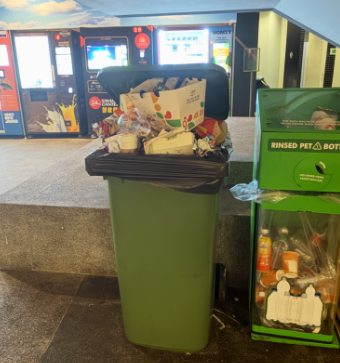
So the next time you toss your soda can into one of these ‘Recycle Right’ bins, take a second look. This humble bin is influencing your behaviour in ways that you do not even realise.
The next challenge for NUS will be tackling contamination in the general green waste bins outside food outlets such as Starbucks at UTown, which are often filled with an unsegregated mix of different types of waste. How might human behaviour be leveraged to fix this problem next?
References:
Ariely, D. (2009). Predictably Irrational. HarperCollins.
Carrier, J. (2026, August 25). Lewin’s Behavior Equation: A Simple Model Of Human Behavior. PeopleShift. https://people-shift.com/articles/lewins-behavior-equation/
Cialdini, R. B., Reno, R. R., & Kallgren, C. A. (1990). A focus theory of normative conduct: Recycling the concept of norms to reduce littering in public places. Journal of Personality and Social Psychology, 58(6), 1015–1026. https://doi.org/10.1037/0022-3514.58.6.1015
Jiang, Q., Izumi, T., Yoshida, H., Dilixiati, D., Leeabai, N., Suzuki, S., & Takahashi, F. (2019). The effect of recycling bin design on PET bottle collection performance. Waste Management, 95, 32–42. https://doi.org/10.1016/j.wasman.2019.05.054
Lim, C. (2026, July 20). Sustainability as behavioural change: Nudging the good, discouraging the bad. CSC Knowledge. https://knowledge.csc.gov.sg/ethos-issue-24/sustainability-as-behavioural-change-nudging-the-good-discouraging-the-bad/
Nudging the NUS Community to Recycle Right. (n.d.). National University of Singapore. https://sustainability.nus.edu.sg/2021/04/30/nudging-the-nus-community-to-recycle-right/



Comments