

Measuring What Matters: Understanding Emissions Reporting
By Tyas Wahyu Pramesti
As organisations worldwide set increasingly ambitious climate targets, one question sits at the centre of meaningful decarbonisation: how can emissions be reduced if they are not first measured accurately?
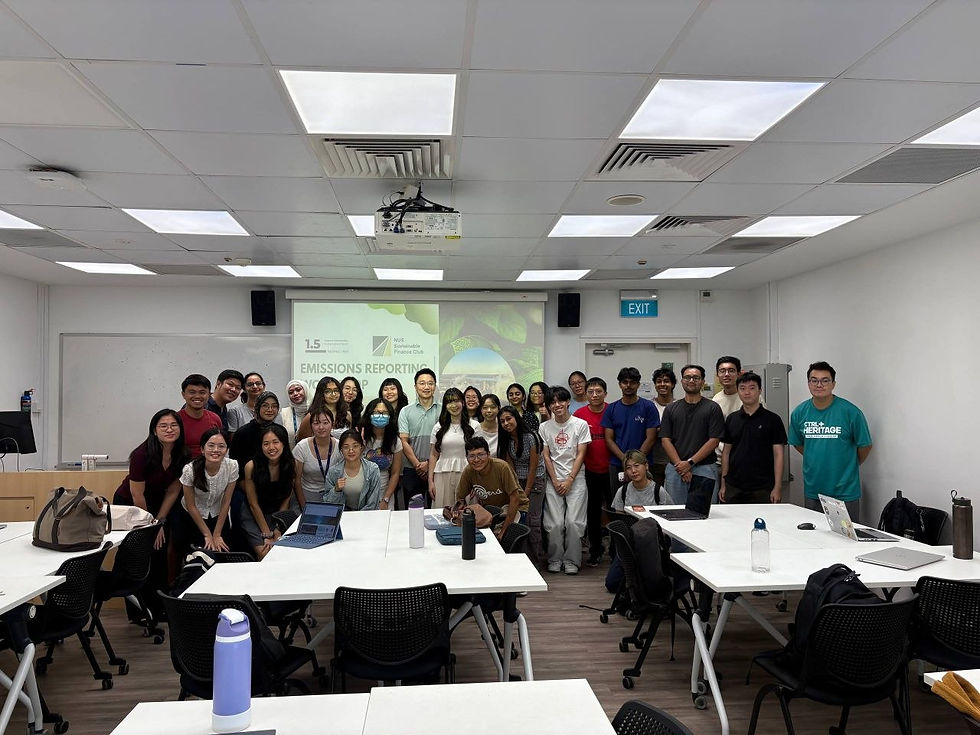
This was one of the key ideas explored during the Emissions Reporting Workshop, jointly organised by 1.5degreeNUS, NUS Sustainability CONNECT and the NUS Sustainable Finance Club on 5 September 2026. The workshop introduced participants to the fundamentals of greenhouse gas (GHG) accounting, including how organisations define their reporting boundaries, classify emissions under Scope 1, 2 and 3, and translate business activities into measurable carbon emissions.
The session began by placing emissions reporting within the wider context of climate change. As global temperatures continue to rise, companies face growing pressure to understand and manage their environmental impact. Yet while terms such as “net zero” and “carbon neutral” are now commonly used, the process behind such commitments is far more technical. Before an organisation can meaningfully reduce its emissions, it must first determine where those emissions originate, which activities to include in its inventory, and how to calculate them.
Dr Sa-Pyung Sean Shin, Academic Director of the MSc in Management and CEMS Master in International Management programmes and Senior Lecturer of Accounting at NUS Business School, led the first segment of the workshop. His academic and professional background closely aligns with the workshop’s focus. Dr Shin holds a Doctor of Business Administration in Accounting and Management from Harvard Business School, a Master in Economics from Toulouse School of Economics, and a bachelor’s degree in Business Economics with a minor in Accounting from UCLA. His research interests include corporate governance and sustainability accounting, and he is also affiliated with the NUS Sustainable and Green Finance Institute. With experience teaching carbon accounting and sustainability reporting, he brought strong academic depth to the session.
Dr Shin introduced participants to the foundations of GHG accounting, beginning with the concept of boundaries. In emissions reporting, boundaries determine what to include in a company’s greenhouse gas inventory.
Dr Shin highlighted two types of boundaries: organisational boundaries and operational boundaries. Organisational boundaries determine which business entities or operations to include, which is especially important for companies with subsidiaries, investments, or joint ventures. Approaches such as equity share, financial control and operational control can influence how emissions are attributed to the reporting company.
Operational boundaries, meanwhile, determine which emission sources are included and how they are categorised. This provides the basis for distinguishing between Scope 1, Scope 2 and Scope 3 emissions.
Scope 1 refers to direct GHG emissions from sources an organisation owns or controls. Examples include fuel combustion in boilers, industrial processing, company-owned vehicles and fugitive emissions such as refrigerant leaks. Scope 2 covers indirect emissions associated with purchased electricity or other forms of purchased energy.
Scope 3 extends much further, capturing other indirect emissions across an organisation’s value chain. Participants were introduced to examples such as third-party logistics, purchased goods and services, employee commuting, business travel, downstream transportation, product use and end-of-life treatment. Real-world examples involving companies such as Shopee, Wilmar and Toyota helped illustrate how emissions can arise both upstream and downstream of a company’s own operations.

The second session was led by Lin Xi Dawn, a Sustainability & Climate Change Associate at PwC Singapore, who recently graduated from NUS as a Bachelor of Social Sciences with Honours (BSocSci Hons) in Geography. Before her current role, she gained extensive experience in sustainability as a Group Sustainability Office Intern at ComfortDelGro, a Programmes Executive at 1.5degreeNUS, and a Sustainability & Climate Change - ESG Intern at PwC Singapore.
In this session, Dawn dived deeper into the real-life implementation of carbon accounting: how companies measure their carbon footprint. Dawn walked participants through the process behind the emission numbers disclosed in companies’ sustainability reports, and the challenges often faced along the way.
Greenhouse gas emission (GHG) reporting is an ongoing cycle that involves four key stages: Measurement, Consolidation, Assurance, and Strategy & Performance. Companies must first set organisational and operational boundaries to define which assets and activities in which business entities are included in the GHG inventory. This helps them set the metrics and data required to measure emissions. Companies then collect activity data from different business units and calculate emissions using a standardised methodology and emission factors. Every assumption made should be documented and disclosed in the report. Third-party auditor assurance can further enhance the credibility and reliability of the reported data. Beyond reporting, companies can track their emissions over time to identify hotspots, compare changes, and understand the factors driving them. These insights can then inform their strategies and performance, creating a feedback loop that helps companies refine their measurements and identify opportunities for further emissions reductions.
Further, Dawn also touched on the challenges companies face with the emission source data. Across scopes and emissions categories, companies need to gather activity data from multiple business units in different formats: operational receipts, supplier invoices, utility records, etc. These inputs may vary in units of measurement, reporting periods, granularity, and even language. Companies, through their sustainability teams, must validate and consolidate the data before using it for reporting. Data incompleteness is another challenge Dawn mentioned. Companies rarely come up with perfect carbon accounting from year one. They typically start with available secondary data, which may come from estimates and industry average emissions. However, because it is less specific and less useful for targeted reduction, companies need to move toward more precise, activity-based primary data collected directly from operations or suppliers.
Dawn also shared a useful tip in handling incomplete or inconsistent data, which is done by diagnosing the cause of the missing data, using proxy or industry averages for estimates, recording the data source and every assumption made, and identifying data owners and improving controls for the next reporting cycle.
Putting these concepts into practice, participants next applied their understanding by analysing the NUS Sustainability Report and identifying which data and activities meaningfully impact campus sustainability and which contribute less. One example discussed was whether planting more trees would have a meaningful impact, considering the time required for trees to mature. Another point was the effectiveness of Bring-Your-Own and Reuse campaigns, especially for online takeaway orders that automatically use the cafe’s non-reusable packaging.
The workshop ultimately highlighted two important points: a company’s carbon footprint does not stop at the boundary of its office or factory, and the quality of the data behind its emissions reporting is fundamental to its credibility. Understanding emissions across the wider value chain, supported by reliable data, is essential for building a more complete picture of environmental impact and for identifying where meaningful reductions can eventually be made.
References
Copernicus Climate Change Service. (2025, January 10). Copernicus: 2024 is the first year to exceed 1.5°C above pre-industrial level. European Centre for Medium-Range Weather Forecasts. https://climate.copernicus.eu/copernicus-2024-first-year-exceed-15degc-above-pre-industrial-level?utm_source=chatgpt.com
Greenhouse Gas Protocol. (2004). A corporate accounting and reporting standard: Revised edition. World Resources Institute & World Business Council for Sustainable Development. https://ghgprotocol.org/sites/default/files/ghgp/standards/ghg-protocol-revised.pdf
Greenhouse Gas Protocol. (2011). Corporate value chain (Scope 3) accounting and reporting standard: Supplement to the GHG Protocol corporate accounting and reporting standard. World Resources Institute & World Business Council for Sustainable Development. https://ghgprotocol.org/sites/default/files/standards/Corporate-Value-Chain-Accounting-Reporing-Standard_041613_2.pdf
National University of Singapore Business School. (n.d.). Shin Sa-Pyung Sean. NUS Business School, https://bschool.nus.edu.sg/cip/our-people/shin-sa-pyung-sean/
National University of Singapore. (n.d.). Reuse campaign. NUS Campus Sustainability. ttps://uci.nus.edu.sg/campus-sustainability/reuse-campaign


Comments